The discovery-call questions that decide a technical deal
Eight high-impact discovery-call questions sales engineers and technical consultants need to answer cleanly: integration, security, pricing, migration risk, scale, ownership, timeline, and competitor comparison.
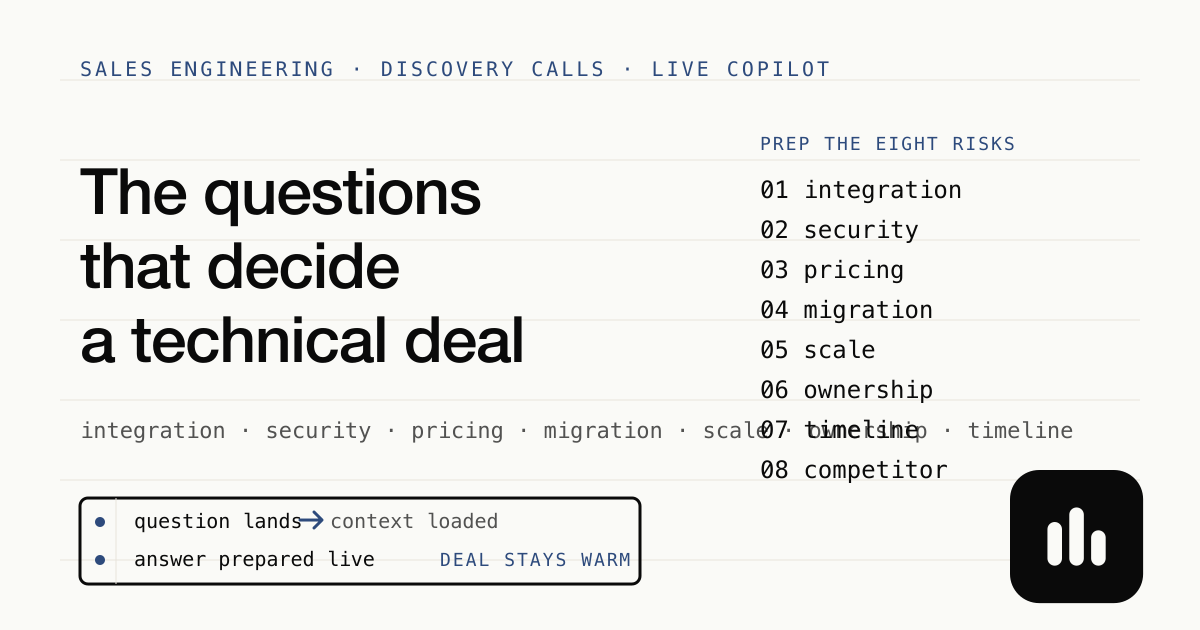
The technical discovery call rarely turns on the demo script. It turns on the question the prospect asks after they have understood the category and start testing whether you can survive their real environment.
For a sales engineer or technical consultant, these questions are not just requests for information. They are confidence checks. The buyer is asking, "have you seen my risk before, and can I trust you to name the constraint without hiding behind a follow-up?"
That is exactly where Minuta fits: it listens locally, follows the live conversation, and helps prepare the answer while the question is still on the table. Load the right docs before the call, and when one of these questions lands, you are not searching from zero.
The eight questions to prepare
1. Integration: "How does this fit into our existing stack?"
What the prospect really wants to know: whether this will become a six-week custom project, create brittle middleware, or force their team to change a workflow that already works.
A good answer: "The core integration is two parts: data comes in through [API / connector / SSO], and the output goes back to [system of record]. The risk area is usually [mapping / auth / rate limits], so we validate that in the first technical session before anyone commits to a rollout."
Load before the call: integration architecture, supported connectors, API docs, SSO/SCIM notes, implementation checklist, and one customer story with a similar stack.
Minuta helps here because your answer can be assembled from the connector doc and the relevant customer story while the prospect is still describing their stack. You sound specific because the context is specific.
2. Security and compliance: "What will our security team object to?"
What the prospect really wants to know: whether bringing you in creates a new vendor-risk process, a data-residency problem, or a recording/privacy issue they cannot defend internally.
A good answer: "The review usually centers on three things: where data is processed, how access is controlled, and what artifacts your security team needs. We can share [SOC 2 / ISO status / DPA / security questionnaire] under NDA, and the key design point is [local processing / encryption / retention control]."
Load before the call: security one-pager, DPA, subprocessors, SOC 2 or ISO status, retention policy, access-control docs, and approved language for regulated buyers.
This is also where Minuta's no-bot meeting copilot matters. For sensitive calls, the fact that the assistant is not joining as a visible recorder can remove an objection before it becomes a procurement thread.
3. Pricing: "Why is this worth the spend?"
What the prospect really wants to know: whether the value is tied to a measurable business outcome or just another seat-based tool competing with their existing stack.
A good answer: "The price makes sense when [costly workflow] is happening often enough. The teams that get the clearest ROI use us to reduce [missed handoffs / slow follow-ups / escalations / technical presales time]. If that is not a real cost for you, the business case is weaker."
Load before the call: pricing rationale, ROI model, packaging notes, discount guardrails, competitor pricing, and two quantified customer examples.
This answer works because it does not apologize. It qualifies. If the prospect does have the pain, you have a path to value. If not, you avoid forcing a weak deal.
4. Migration risk: "What breaks when we move from our current process?"
What the prospect really wants to know: whether adoption will create chaos for the people who already own the old workflow.
A good answer: "The main migration risk is not the data move; it is behavior change. We usually keep [old process] running in parallel for [time window], move [first team / first workflow] first, and only retire the old flow after the success criteria are visible."
Load before the call: migration plan, rollout checklist, data import/export docs, training plan, admin guide, and examples of phased adoption.
This is a good moment to connect the prospect to a trial path. If they are worried about disruption, send them to downloads after the call with a narrow pilot plan instead of a broad rollout promise.
5. Scale: "What happens when this is 10x bigger?"
What the prospect really wants to know: whether your product has a real operational boundary and whether you will name it before they find it in production.
A good answer: "We are comfortable up to [known level] with [configuration]. Above that, the constraint is usually [latency / queueing / API limits / permissions complexity]. The mitigation is [architecture choice], and we should size that against your actual usage pattern."
Load before the call: benchmark notes, capacity limits, architecture diagram, largest-customer profile, rate-limit docs, and escalation paths for enterprise deployments.
A strong scale answer includes a boundary. "Unlimited" sounds less credible than "here is the limit we have tested and the way we plan around it."
6. Ownership: "Who will own this after purchase?"
What the prospect really wants to know: whether the product will become an orphaned tool that sales, solutions, operations, security, and IT all expect someone else to manage.
A good answer: "The best owner is usually [role], with [role] involved for security and [role] involved for workflow design. In the first 30 days, the owner needs to make three decisions: users, source systems, and success metrics."
Load before the call: implementation RACI, onboarding plan, admin permissions, success plan, enablement checklist, and examples of internal ownership models.
For sales engineers, this question is a buying-signal question. The prospect is already imagining the tool inside their company. Help them make that picture operational.
7. Timeline: "How fast can we go live?"
What the prospect really wants to know: whether your timeline is real or a sales promise that ignores security review, integrations, training, and data cleanup.
A good answer: "If [dependency] is ready, a small pilot can be live in [timeframe]. A broader rollout usually takes [timeframe] because of [security / SSO / data mapping / enablement]. The fastest path is to define the pilot workflow today and identify the one blocker that would slow it down."
Load before the call: pilot plan, implementation milestones, procurement checklist, technical dependencies, onboarding emails, and launch criteria.
This is where a live copilot helps you stay precise. Instead of guessing, you can pull the implementation checklist into the conversation and answer with the actual dependency tree.
8. Competitor comparison: "Why you instead of the product we already know?"
What the prospect really wants to know: whether your difference matters enough to justify switching cost, political risk, and explaining the decision internally.
A good answer: "If your priority is [competitor strength], they may be a good fit. Teams choose us when [your wedge] matters more: [reason 1], [reason 2], and [reason 3]. The useful question is which trade-off matters most for your team."
Load before the call: battlecards, competitor matrix, win/loss notes, approved positioning, proof points, and the internal "when we should not win" guidance.
For Minuta, the wedge is live help in difficult English calls without sending audio to a cloud meeting bot. That is different from a generic recorder or a post-call note taker. Use that wedge to prepare the exact phrasing before a technical buyer starts testing your constraints.
How to use the list before a call
Do not memorize every answer. Build a call pack:
- The account's stack and likely integration path.
- The security/compliance artifacts they will request.
- Pricing rationale and the one ROI argument that fits their role.
- Migration risks and the smallest credible pilot.
- Scale limits, ownership model, timeline, and competitor trade-offs.
Then load that pack into the workspace you use during the call. Minuta's job is not to replace your judgment. It is to shorten the distance between hearing the question and having the right context, sentence shape, and follow-up artifact ready.
That distance is where technical deals are won.