How to answer technical questions in English meetings
A practical answer framework for sales engineers, consultants, and tech leads who know the technical answer but freeze when they need to explain it in English under pressure.
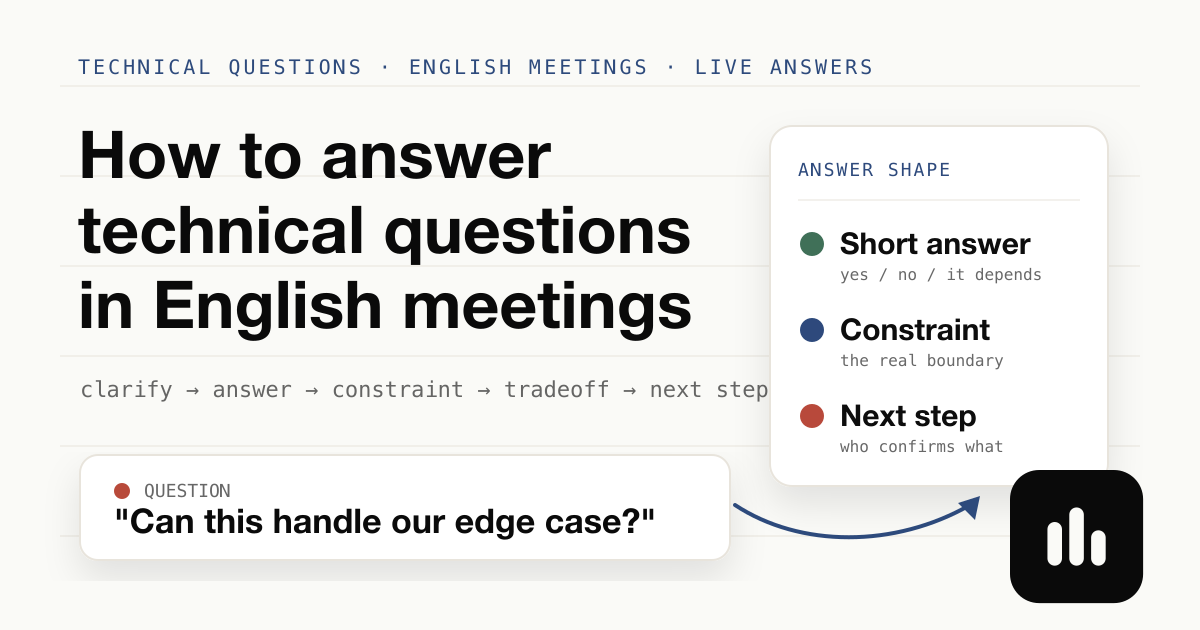
You know the answer. That is the frustrating part.
The customer asks how the integration behaves when the queue backs up. Your tech lead asks why the migration plan has two phases. A partner wants to know whether the data model can handle their edge case. In your native language, you would answer in 20 seconds and move the room forward.
In English, under pressure, the answer gets stuck between the technical idea and the sentence you need to say. You start with "it depends", add too much context, lose the main point, and finish by promising to follow up. The room does not see the part you know. It only hears uncertainty.
This post is a field guide for that moment. It is useful even if you never use Minuta: short answer shapes, clarifying questions, and a repeatable constraint/tradeoff/next-step structure you can use in any technical meeting.
The goal is not perfect English
In a hard technical meeting, the goal is not to sound native. The goal is to sound clear, senior, and safe to trust.
That means three things:
- answer the question they actually asked;
- name the constraint instead of hiding it;
- give the next step before the room invents one for you.
Most non-native professionals fail in the middle. They either say too little because they are afraid of making a language mistake, or they say too much because they are trying to prove they know the topic. Both choices make the answer weaker.
The fix is to use pre-built shapes. You do not need a memorized script for every question. You need a small set of frames that turn the technical answer into English quickly.
Start with a clarifying question
A clarifying question is not a delay tactic. It is how you show you understand the shape of the problem before answering.
Use one when the question is broad, ambiguous, or hiding a decision:
"When you say scale, are you mainly worried about request volume, data size, or latency?"
"Do you want the short answer for feasibility, or the implementation tradeoff?"
"Is the concern security review, user experience, or operational risk?"
The trick is to offer options inside the question. "Can you clarify?" puts work back on the other person. "Are you mainly worried about A, B, or C?" proves you already understand the possible paths.
For a sales engineer in discovery, this does two jobs at once: it buys you three seconds of thinking time, and it turns a technical challenge into better qualification. For an independent consultant, it keeps you from answering the wrong version of the question and accidentally expanding scope.
Use the 15-second answer shape
When the question is clear, answer in this order:
- Direct answer.
- Constraint.
- Tradeoff.
- Next step.
Here is the generic shape:
"Short answer: yes, we can do that. The constraint is [X]. The tradeoff is [Y]. The next step is [Z]."
That sounds almost too simple, but it works because it separates confidence from complexity. The first sentence gives the room an answer. The next sentences show that you know where the edges are.
Example:
"Short answer: yes, we can support that integration. The constraint is that your current webhook payload does not include the account-level identifier. The tradeoff is either adding that field upstream or doing a lookup on our side. The next step is to confirm which team owns that payload."
That is much stronger than:
"Yes, I think maybe it should be possible, but we need to check the webhook payload, because depending on your architecture maybe we need some change."
The technical content is similar. The first answer sounds senior because it has shape.
Keep a few answer frames ready
You do not need fluent improvisation. You need reliable openings.
Feasibility
"Yes, technically it is possible. The real question is whether we want to pay the complexity cost."
Use this when the answer is "yes, but not for free". It prevents the room from hearing "possible" as "easy".
Limitation
"Today, no. The current limitation is [X]. The workaround is [Y], and the proper fix would be [Z]."
Use this when the honest answer is no. A clean no with a path forward builds more trust than a vague yes.
Comparison
"The difference is where the responsibility lives. Option A puts it in [system/team]. Option B puts it in [system/team]. That changes [cost/risk/user experience]."
Use this when someone asks "why not just use X?" You are not defending a preference. You are explaining a boundary.
Unknown
"I do not want to guess on that number. What I can say now is [known fact]. I will confirm [specific detail] and send it after the call."
Use this when you genuinely do not know. The key is to answer with what you do know first, then make the follow-up specific. "I will check" is weak. "I will confirm the timeout value in the enterprise plan" is strong.
Replace long explanations with signposts
When you feel pressure, you may try to explain the whole system. Do not. Signpost the answer instead:
"There are three parts: ingestion, processing, and retention."
"The risk is not performance. The risk is operational ownership."
"This is mostly a data-contract question, not an infrastructure question."
Signposts help the room follow you. They also help your own brain stay on track. If you are a tech lead presenting tradeoffs, this is the difference between sounding like you are thinking out loud and sounding like you are guiding the decision.
The one sentence that saves bad answers
If you realize your answer is getting messy, stop and reset:
"Let me make that simpler."
Then give the 15-second version.
This sentence is underrated. It lets you recover without apologizing. It tells the room that you noticed the answer needed structure, and you are now giving it structure.
Prepare context, not scripts
Scripts fail because real questions are too specific. Context works because the raw material is already there: architecture notes, customer examples, security answers, pricing rationale, product limits, implementation details.
Before a high-stakes English meeting, prepare a small answer bank:
- three recent customer examples;
- the current product limits you are allowed to say out loud;
- the exact numbers people ask for: latency, retention, throughput, SLA, price;
- the phrases you use for "yes but", "no but", and "I need to verify";
- links to the docs you will need if someone asks for detail.
That is the workflow Minuta is built around. It listens to the meeting live, uses your docs and call context, and suggests a short answer while you are still in the conversation. It is not there to invent expertise you do not have. It is there to help you turn the expertise you already have into clear English under pressure.
If you are frequently in calls where the technical question decides the deal, look at the sales engineer discovery call and AI meeting copilot use cases. If you want to try it on your own meetings, start from downloads.
A simple practice drill
Take five questions you were asked last week. For each one, write a 15-second answer using this shape:
"Short answer: [yes/no/it depends]. The constraint is [X]. The tradeoff is [Y]. The next step is [Z]."
Then say each one out loud twice. Not to memorize the exact words. To make the shape automatic.
The next time the difficult question lands, you will still feel pressure. That part is normal. But pressure is easier to handle when the answer has a path: clarify, answer, name the constraint, explain the tradeoff, give the next step.
That is enough to sound like what you already are: the person who knows the answer.